
Executive Summary
Given testing performed at the AET Innovation Center, Alpha FR 3T will provide the best solution for an anionic FR in the presence of excess oxidizing agent. Alpha FR 809C also provided a solution as well, however given cost and the communicated need to also use anionic FRs still indicate 3T is the better choice. Alpha FR 6T, being identical to 3T except at higher activity, would also give an economic solution.
Option 1: Alpha FR3T
Option 2: Alpha FR6T
Option 3: Alpha 809C
AET FRs do not appear to be materially impacted by excess oxidizing agents.
Test Procedures
Synthetic Brine Composition
A synthetic water makeup matching the customer’s correspondence was generated matching Table 1 below for the water source.
Table 1. Permian water quality ICP data, supplied by a major operator in the Permian.
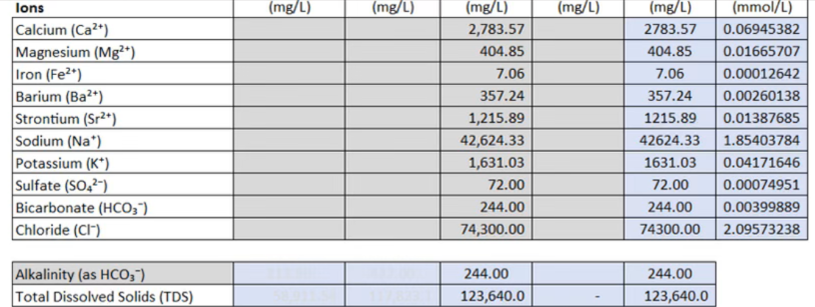
Exact masses below (g) were added to 5.5 gal of Houston tap water as follows, and allowed to dissolve and flow through a Chandler 7700 friction loop for 10 minutes at a rate of 2 gpm, when the solution appeared homogenous:
Table 1. Exact salt mass (g) used to generate synthetic makeup water.

Flow Loop Tests
A Chandler 7700 flow loop equipped with both a ¾” and ½” 40 ft pipe with pressure sensors was used to determine friction reduction during pumping. A flow regime which incorporates several rate changes was included in the testing to determine shear sensitivity of the individual products at different rates. Below is an image of the flow loop used in testing, and a screenshot of the rate schedule.

Figure 1. Rate schedule used for standard flow loop testing.
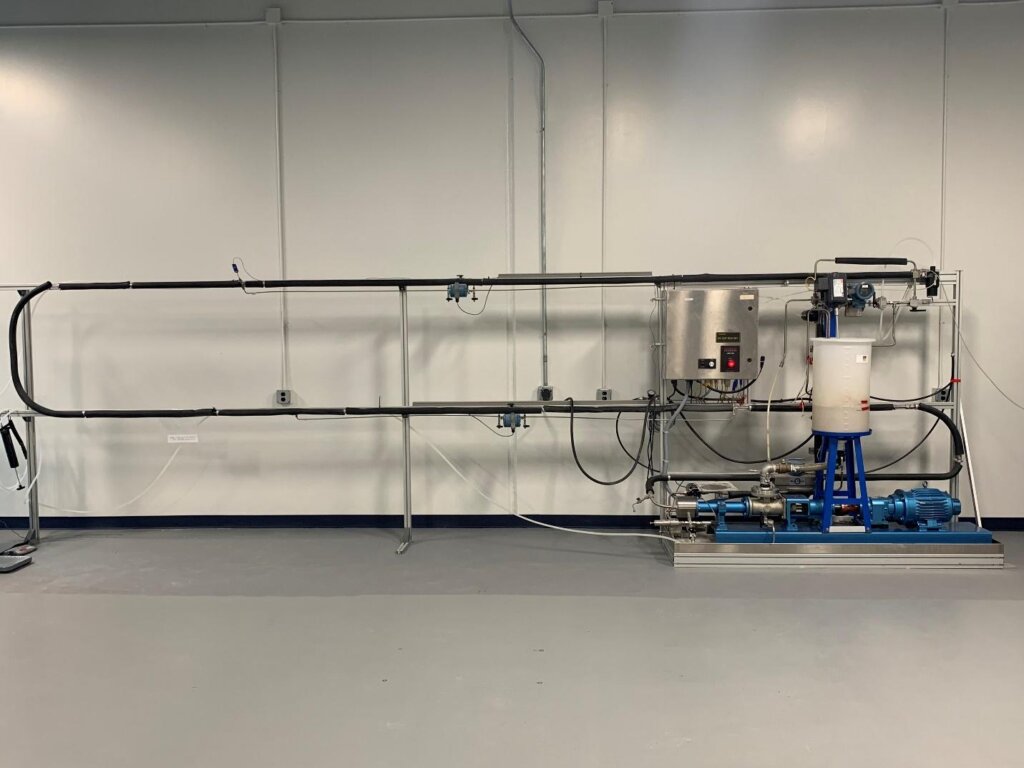
Figure 2. Flow loop used for this testing.
For each individual test, the schedule is started and allowed to achieve a steady base rate without friction reducer product and the appropriate amount of friction reducer product is added to the reservoir at once via syringe, fully dosed in less than 3 seconds. The change in pressure is monitored electronically over the course of the test and calculated to % friction reduction.
Cleaning the flow loop after and between tests is done by combinations of serial dilution and draining followed by the use of sodium perborate (between 5 and 10 grams per test) to oxidatively cleave any residual friction reducer, a process taking around an hour per test.
Test Results
Tests were performed using several friction reducers which have given successful previous results in lab studies, and in products which have given superior results in full scale deployment in west Texas as well.
Oxidizers Beyond ICP Data
In a lunch meeting with our client, he mentioned that a large excess of chlorine dioxide was going into the water, and causing the fundamental issues requiring a cationic FR. To test closer to operational conditions, we used our client’s statement of ORP of as high as 600 and were able to calculate this as being around 5 ppm excess residual chlorine dioxide. We do not have a chlorine dioxide generator or the reagents in the lab to recreate this exactly, however we are able to use bleach and get the same active reagents in flow loop testing (the hypochlorite radical is a stronger oxidizer than the chlorine dioxide, but they all generate this same active species).
The tested water with sodium hypochlorite generates an active residual that would be 900 ORP, or around 7–8 ppm excess chlorine dioxide.
Friction Loop Testing
Friction loop tests were conducted to determine viable candidates for the two water sources. These tests were run using the equipment and schedule described above. For ease of comparison, all FR products were added to the flow loop reservoir 2 minutes from the schedule initiation and added all at once.
Flow loop testing was conducted at a lower dosage of 0.5 gpt primarily to stress the friction reducer’s individual ability to perform in these waters. These should not be used as an optimized indication of field and full deployment dosage, which will vary by well conditions, pump time, pump rate and sand schedule.
From the graphs below, we do not see any significant degradation of our production Alpha FR 3T or the experimental 809C through the standard testing we use. The minor degradative behavior for 3T under the higher shear region is similar to what we see in waters in this TDS realm and given the field history would still do well in this water. The 809C also performs well, and its lack of degradation is what we have seen for it in water sources at or above this TDS level.
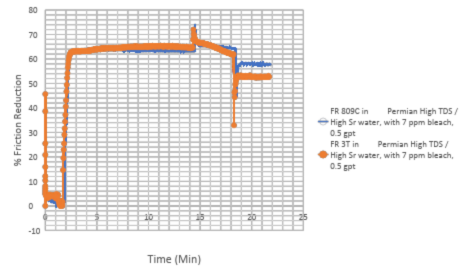
Figure 3. Higher concentration FRs tested via flow loop in synthetic Delaware basin waters via flow loop.
Conclusion
Testing for inversion speed and flow loop testing all indicates that Alpha FR 3T (and the more concentrated version 6T) will give superior performance. Alpha FR 809C will also perform well but does not meet the strategic goal of an anionic FR, which improves overall chemical compatibility with more additives.