
Executive Summary
AET tested both 6T and 3T in both water sources and found that 6T outperformed. AET tested standard 2 gpt loadings for viscosity measurements and derived power law constants for both 6T and 3T, both at room temperature and at 150 °F to alleviate any concerns about downhole conditions. Alpha FR 6T had better viscosity profiles and power law parameters in this water source, and would give corresponding better performance on location. Attached is the water makeup which we reconstructed in the lab for testing.
Test Procedures
Synthetic Brine Composition
A synthetic water makeup matching the customer’s correspondence was generated matching.
Exact masses below (g) were added to 1 L of Houston tap water as follows, and allowed to dissolve and blended until reasonably homogenous:

Dynamic Viscosity Testing
Viscosity testing was conducted with a Grace M3600 viscometer equipped with an R1B1 bob. A timer was started followed by samples added at appropriate dosages (0.4 mL for 2 gpt) in 200 mL of synthetic water (produced from the recipe above in 2L batches). These were blended at approximately 800 rpm for 15 seconds and then measured under continuous shear of 511 sec⁻¹ on the viscometer with timed measurements as indicated in the results.
Test Results
Tests were performed using both Alpha FR 3T and Alpha FR 6T which has given successful previous results in lab studies, and in products which have given superior results in full scale deployment in West Texas as well.
Viscosity Testing
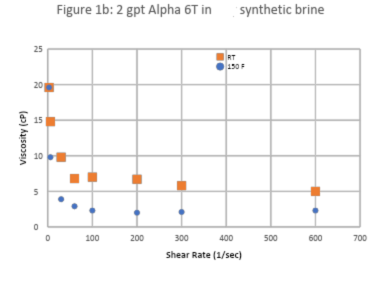
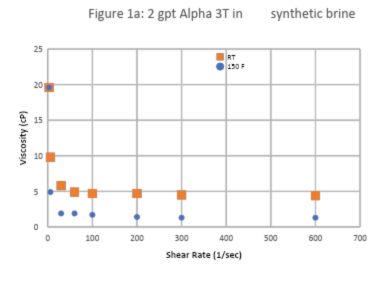
Figure 1a, 1b. Viscosity development vs shear at two temperatures, AET FRs. 2 GPT of FR was blended in synthetic produced water for 15 seconds at approximately 600 rpm, then immediately measured at various shear using a Grace 3600 viscometer equipped in an R1B1 configuration.
Table 1a: 6T Power Law parameters and key measurements
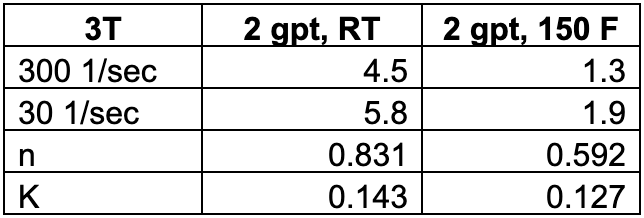
Table 1b: 6T Power Law parameters and key measurements
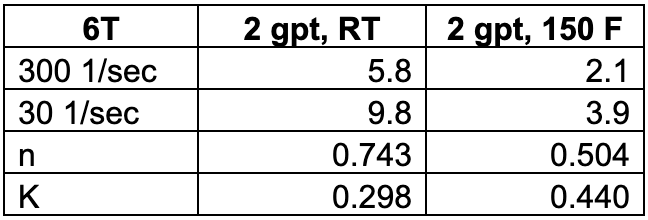
Table 1a, 1b: Key Power Law values and viscosities for 3T and 6T at 2 gpt.
Power law values n and K were derived using the standard equations for drilling muds, and as expected varied on concentrations and on water quality. The increased consistency values for 6T are expected.
Conclusion / Discussion
AET tested both 6T and 3T using the water makeup provided by a major operator. This primarily focused on viscosity tests over friction reduction, partially for a faster conclusion and because the water provided is very close in composition to water being used with 3T currently without any issues (only 4,000 ppm TDS difference). These tests found that 6T outperformed, though both products did well: 6T is a higher concentrate version of 3T, and in some cases 3T is appropriate and in tighter wells with higher pressure 6T is more appropriate.
We designed the viscosity tests to allow us to derive both n and K values both at room temperature and at 150 °F, mainly to test for differences in performance in toe vs heel stages, for frac modeling software which includes fluid parameter inputs. Similarly to the viscosity tests, this should not be used as an optimized indication of field and full deployment dosage, which will vary by well conditions, pump time, pump rate and sand schedule.